
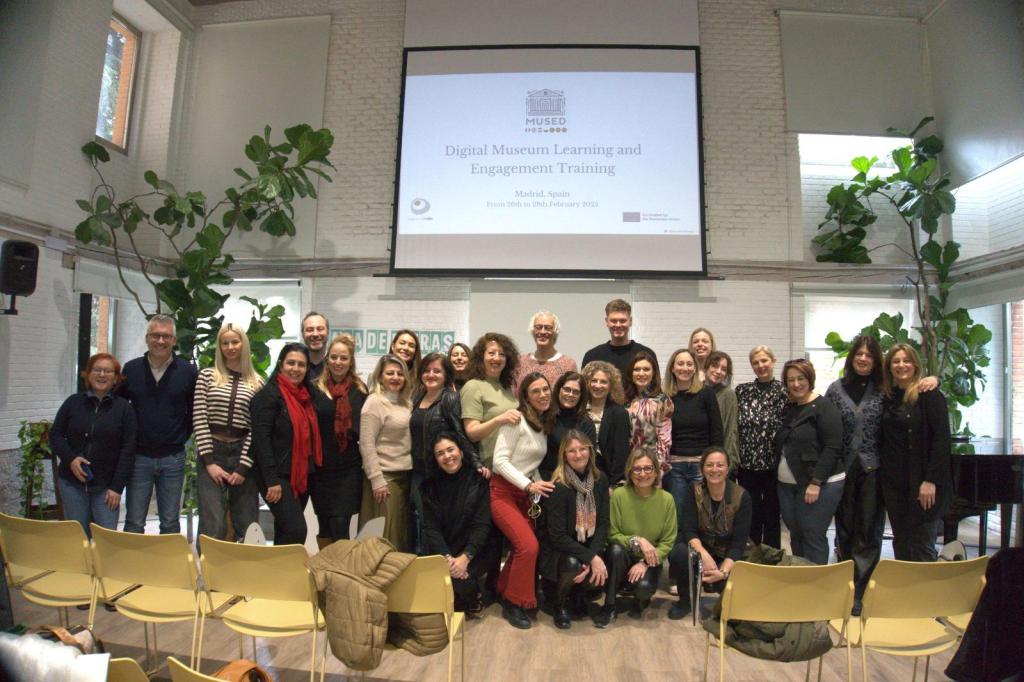
The international meeting of the MUSED project – Museums Uniting Students and Educators in Digital and Historical Exploration in Madrid for a training dedicated to digital museum education has been successfully concluded.
MUSED involves schools and cultural institutions from seven European countries and aims to experiment with innovative approaches to teaching, exploiting digitalization and new technologies to make museums spaces of active and inclusive learning.
The MUSED project involves a consortium of European partners, each with a key role in achieving the educational and technological objectives.
From 26 to 28 February, teachers participated in an intense three-day training at the Eugenio Trías Public Library – Casa de Fieras de El Retiro. The program, developed by the host association, Espacio Rojo, included interventions by international experts on the integration of digital in museum education and practical workshops for the creation of interactive learning experiences.
One of the most significant moments was the visit to the Prado Museum, considered one of the most important museums in the world. Suffice it to say that in 2024 it recorded almost three and a half million visitors. Numbers that are not surprising if you consider that it houses over 311 paintings from the Royal Collection and some of the most important works by the greatest Spanish, Italian and Flemish artists, including Beato Angelico, Andrea Mantegna, Raffaello Sanzio, Hieronymus Bosch, Rogier van der Weyden, Bruegel the Elder, El Greco, Peter Paul Rubens, Titian, Caravaggio, Diego Velázquez, Rembrandt, Francisco Goya.
During the visit to the Prado, the participants had the opportunity to meet the professionals who develop educational projects for teachers and students for the Museum. With them they explored the educational methodologies used to enhance cultural heritage through technology and creativity. During the workshops, the teachers experimented with digital tools for the creation of innovative educational content.
In the coming days, the project partners will publish the methodological guide on the use of digital tools, which will be useful for teaching through cultural heritage. Subsequently, the teachers involved in the Madrid mobility will implement what is provided in the guide with practical activities that will directly involve the students. Finally, a training workshop will be held for school colleagues, sharing tools and methodologies learned. The path will culminate in July 2027 with the creation of a twinning between the European schools involved, which will collaborate in the creation of the European Virtual Museum, an interactive digital environment where students will contribute to the digitization and valorization of the local cultural heritage.
 MUSED
MUSED 
Lascia un commento